
Mold remediation in Fort Lauderdale, FL
Mold in a Fort Lauderdale home nearly always starts with water that stayed put: an overflowing AC drain pan, a supply line weeping inside a vanity, or a room that took on rain or tide water and was never dried out. The EPA's guidance is to dry water-damaged areas and items within 24 to 48 hours to keep mold from growing, and to hold indoor humidity under 60 percent.
Florida treats larger mold jobs as licensed work. Under section 468.8411 of the Florida Statutes, mold remediation and mold assessment mean work on more than 10 square feet, and section 468.8413 requires a state license for each. Section 468.8419 also says a remediator may not assess the same structure within 12 months of remediating it (and the reverse), so testing and removal usually come from two different companies.
Your call is connected with an independent local company. Water category for this page: any water left in place more than 24 to 48 hours.
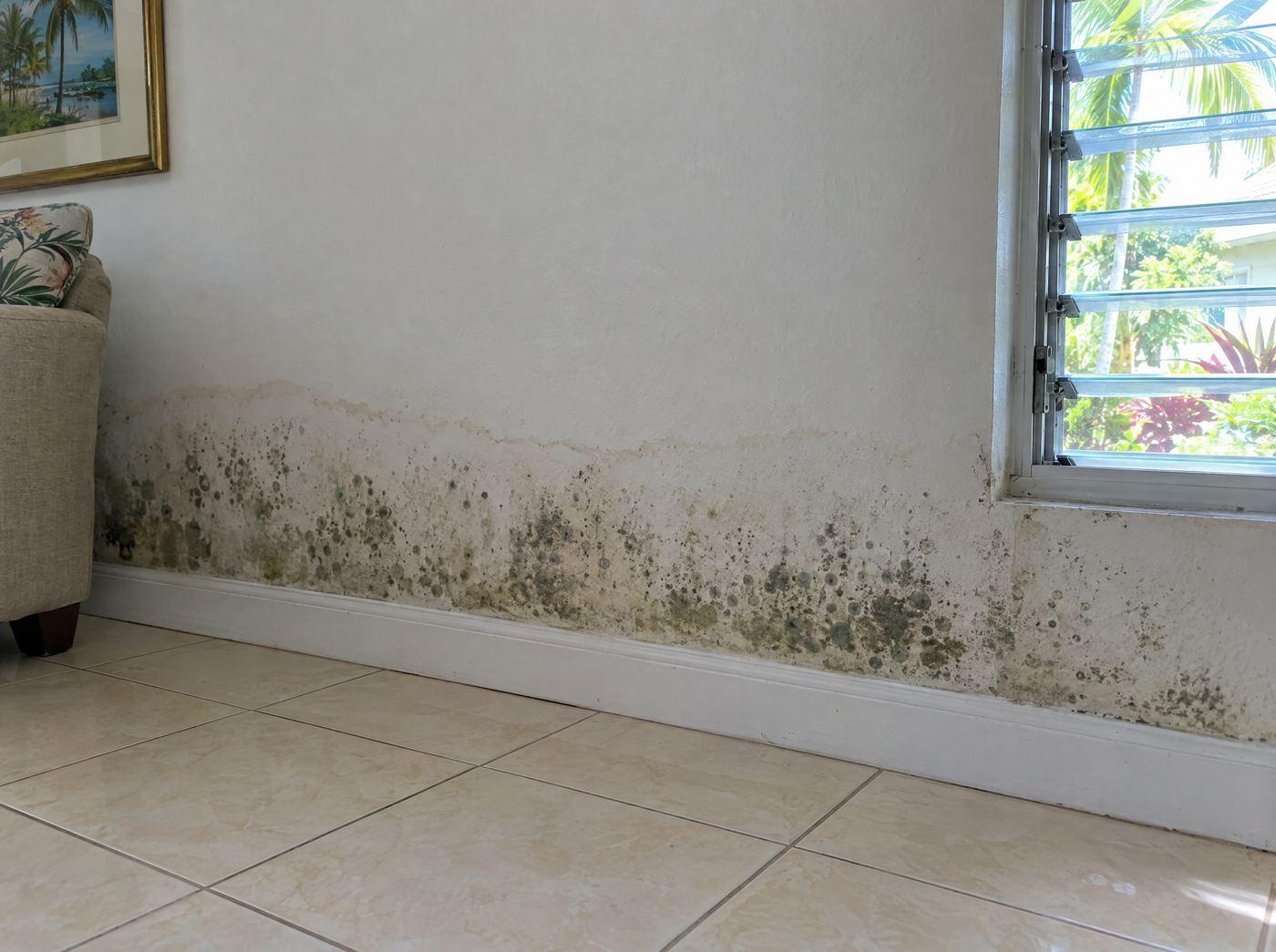
Illustrative photo.
Right now
- 1Find the water first. Mold keeps growing as long as the moisture behind it is still there.
- 2Shut the door to the room and leave the growth alone. Scraping or vacuuming it with a household vacuum spreads spores.
- 3If the mold is around the air handler or a supply vent, ask before running the AC hard. Moving air can carry spores to other rooms.
- 4Don't paint over a stain or seal it with caulk. It hides the problem and makes the next inspection harder.
- 5Take photos for your records, and write down when the leak started if you know.
Fort Lauderdale facts for this problem
Florida defines mold remediation and mold assessment as work on more than 10 square feet of mold, and requires a state license for each.
Source: Fla. Stat. 468.8411.
A Florida mold remediator may not assess a structure it remediated within the previous 12 months, and an assessor may not remediate a structure it assessed in that time.
Source: Fla. Stat. 468.8419.
Florida requires a licensed mold remediator to carry general liability insurance of at least $1,000,000.
Source: Fla. Stat. 468.8421.
June is the wettest month at the Fort Lauderdale climate station, with a 1991-2020 normal of 9.55 in.
Source: NCEI 1991-2020 normals via ACIS, Fort Lauderdale record.
May through October bring 43.80 in. of the station's normal 60.95 in. a year (1991-2020 normals).
Source: NCEI 1991-2020 normals via ACIS, Fort Lauderdale record, calculated by Lauderdale Flood Line on November 12, 2026.
September 2026 brought 22.34 in. of rain to the Fort Lauderdale record, the wettest September since it began in 1912; the next was 1998 with 18.40 in.
Source: ACIS daily record, Fort Lauderdale Area record (now Fort Lauderdale/Hollywood International Airport), calculated by Lauderdale Flood Line on November 12, 2026.
Before mold work starts in Fort Lauderdale, look up the remediator's license number on the DBPR license search. Florida Statutes section 468.8421 requires a licensed mold remediator to carry general liability insurance of at least $1,000,000, so ask for the certificate. The EPA's indoor humidity target is under 60 percent; our rain and humidity page shows today's outdoor humidity and dew point at the airport station.
Sources: Florida DBPR license search; Fla. Stat. 468.8421; EPA: A Brief Guide to Mold, Moisture and Your Home
What the work usually involves
Use this as a checklist when a company walks you through the job.
- Moisture checkMoisture meters and often a thermal camera are used to find where the water is now, because dry-looking drywall can still be wet behind the paint.
- ContainmentPlastic sheeting and an air scrubber set to pull air out of the work area keep dust and spores from drifting into clean rooms.
- Removal and cleaningPorous materials with growth, such as drywall, insulation and carpet pad, are cut out and bagged. Wood framing and other solid surfaces are cleaned.
- DryingDehumidifiers run until the framing and slab read dry. In a humid month that step can take longer than the removal.
- Check before closingReadings are taken again before new drywall goes up. If you want independent clearance testing, a separate licensed assessor does it.
How insurance usually treats it
Many homeowners policies cap mold coverage at a small sub-limit or exclude it, but the water loss that caused the mold may be treated differently from the mold itself. Your declarations page and the mold endorsement, if there is one, say which applies. Read them or ask your agent before work starts so the scope and the paperwork match.
General information, not insurance advice. Your policy decides. Florida rules at a glance.
What changes the size of the job
- Square footage of growth and whether it passes the 10 sq ft licensed-work line
- Where it is: open wall, inside the AC closet, in the ductwork or above a ceiling
- How much drywall, insulation and flooring has to come out
- Containment and air filtration needed while the work is underway
- How long drying takes after removal
We don't quote prices. A company measures moisture on site and writes an itemized estimate.
Questions people ask
Does Florida require a license for mold removal in Fort Lauderdale?
Yes, once the job is larger than 10 square feet. Florida Statutes section 468.8411 defines mold remediation as treating more than 10 square feet of mold, and section 468.8413 requires a license from the Department of Business and Professional Regulation. You can look up any license number on the DBPR license search.
Can the same company test for mold and remove it?
Not on the same home within 12 months, under Florida Statutes section 468.8419, with a narrow exception for certain Division I contractors. If you want air or surface sampling, hire the assessor separately from the company doing the removal.
Can I clean small mold spots myself?
The EPA says areas smaller than about 10 square feet can often be cleaned by the homeowner. If the mold came from sewage or other contaminated water, the EPA suggests a professional with experience in that kind of cleanup.
Why does mold keep coming back near my AC closet?
Usually because the moisture never left. A clogged condensate line or a rusted drain pan can keep a closet floor or wall damp for weeks. The EPA recommends keeping drip pans clean and drain lines flowing. See the AC leak page for what to check.